

I recently happened across a media consumption survey from a company called Attest (billed as an “AI consumer insights engine for global B2C brands,”), and let me just say: From the first page of data through the very end, I felt simultaneously extremely discouraged and confused (as a human) and overwhelmed and intrigued (as a marketer) at the sheer amount of media we’re ingesting on a daily basis … as well as what we can do with that knowledge.
What could we do with 12 hours a day?
When looking at individual media categories, streaming services, YouTube and live TV take the top three spots of daily consumption, none of which is altogether surprising to me. Where it does get surprising (and the other emotions listed above), is when you add up the time spent consuming all of these media types per day, which I, of course, did.
And in doing so, it seems that on average, Americans spend 11.76 hours per day consuming media.
Nearly half the day is spent consuming media. In a 24-hour period, if we take out about eight hours for sleeping, that leaves only four waking hours a day that Americans aren’t spending time with some kind of media, be it TV, social media, music, podcasts, books, websites or other.
Four. Hours.
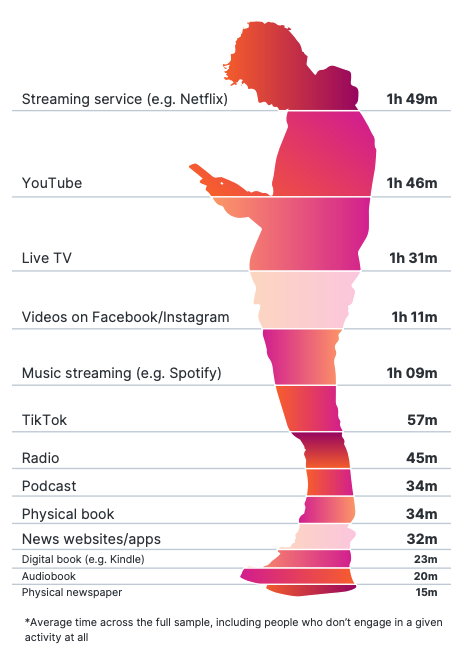
(As a caveat, media consumption isn’t necessarily 11.76 unique or uninterrupted hours of attention. People multitask, and the study notes that its figures exclude non-video social media consumption. So I wouldn’t take that number as a literal measurement of human attention. Still, the scale is pretty remarkable.)
On a human level, I find this shocking and extremely discouraging. But since this is a blog from a marketing agency, let’s look at this from a marketing angle.
On average, Americans spend 12 hours a day with media. That means there are a lot of opportunities for marketers to get in front of them. This of course differs by age: Gen Z and Millennial consumers consume even more than 12 hours a day (13h 30m for Gen Z, 12h 51m for Millennials); Gen X and Boomers less (10h 3m, 8h 35m, respectively).
So with this much media consumption happening every day, how are we not reaching our audiences?
I think the answer is that the problem isn’t a lack of media opportunities. It’s that there are now so many opportunities (and so many different ways people use them) that simply knowing where people spend time isn’t enough.
And based on this data and my 15 years as a marketer, I think there are two questions brands and orgs have to answer:
Who is our audience?
Where, and how, is that audience actually spending its time?
If number one is your issue, you really have to solve it before you dive into marketing at any depth. If you don’t know who your customers, members or constituents are, no amount of channel optimization is going to save you. You can’t make data-backed decisions if you don’t have data.
So let’s assume number one isn’t your issue. You know who your audience is.
That brings us to number two.
Finding the right channels
Twelve hours of daily media consumption feels like an almost endless amount of opportunities to reach your audience. But when you pare it down by channel, the task becomes much more complicated.
Think about asking a five-year-old what they want for a snack vs. giving them two specific options. With just two choices, they have parameters to operate within, and a clear, expected outcome. Ask an open-ended question and suddenly you’re negotiating over dinosaur-shaped nuggets you don’t even have in the freezer.
In marketing, it’s similar: There’s now an overwhelming number of places where your audience could be. And even if you know which platforms they use, that doesn’t necessarily tell you how they use them.
Your audience might be on YouTube, but are they watching product reviews? Documentaries? Tutorials? Creators they follow? On TikTok, are they there to doomscroll or for entertainment? Inspiration? Recommendations? If they listen to podcasts, are they listening to industry news, comedians, true crime or something completely unrelated to your business?
This distinction matters because the goal isn’t to find everywhere your audience spends time, it’s to understand where they’re spending time, what they’re doing there, and where your message actually fits.
Creators as channels
One of the biggest shifts in the data is the amount of time Americans spend consuming creator content. According to the report, Americans spend nearly four hours a day watching creator content on platforms like YouTube, TikTok and social video (vs. 3h 20m for live and streaming TV). I’m not saying I read this and think “TV is dead”—over three hours of TV a day is not nothing. Instead, this reads to me that the definition of a media channel has changed.
For a long time, the media list for marketers was relatively simple. We could boil it down to traditional vs. digital, or even to a longer list of channels like TV, radio, print, outdoor, web, social, email. But now, “social” is much too complex to be called a single channel, as is something like “video.” Both of these represent collections of platforms, creators, communities, formats and audiences, and increasingly, the person making the content is part of the channel.
This is important because leveraging creators don’t simply give brands another place to buy an ad, they give brands access to an existing audience relationship. The creator has already earned that audience’s attention (and often trust), has a particular voice, and has built a community around a shared interest. This creates a huge opportunity for marketers to go beyond understanding which social platform their audience is on to identifying whose content their audience chooses to spend time with.
What this doesn’t mean: Immediately abandon your marketing strategy and dump all your resources into an influencer campaign.
What this does mean: Stop thinking about channels only as platforms and start thinking about them as the places, people and communities your audience has chosen to pay attention to.
Social and video as search
Another implication of all this media consumption? People aren’t just consuming content or using them for entertainment; they’re using them to find things. Search behavior is changing, and people no longer rely primarily on Google. If your audience is using TikTok to discover a product, Instagram to find inspo and YouTube to get a tutorial, you need to think about what it means to be findable in these places.
This is where you can combine media-consumption data (like this Attest report) with your own audience data. For example, say your members or customers are primarily Millennials, a demographic customer research shows spends a lot of time on YouTube. With this as your starting point, you can ask better questions: What are they watching? What do they search for? Who do they trust? What problems or challenges do they have? What types of content get them to watch, subscribe, comment, click or share? The answers can determine everything from content topics and media placements to creator partnerships, keywords and creative.
What this doesn’t mean: Create a piece of content for every possible platform and outcome.
What this does mean: Understand how your specific audience uses each platform and show up accordingly.
Engagement > attention
The 12-hour/day media consumption number is shocking at face value, but we need to be careful with it. Just because someone is consuming media doesn’t mean they’re available to be marketed to.
For one, we can go ahead and exclude types of media that don’t have media placements available, like physical and e-books, most audiobooks, and non-ad tier streaming and music services. There are other layers here, too—like someone who’s listening to a podcast while driving but isn’t (read: shouldn’t be) in a position to click a link. Someone who’s doomscrolling TikTok on their lunch break may not be in the headspace to comprehend your marketing content as they scroll past. Someone who’s watching YouTube on their TV while sending their friends Reels on Instagram might not be paying attention when your ad shows up—or only give it enough thought to press “Skip.”
The goal can’t simply be to maximize impressions; it has to be to understand context and behavior. Put another way, you don’t just want your ad or content to play in an empty room while someone’s topping off their bev. You want it front and center when they’re completely paying attention and can act on it.
(Don’t get me wrong, reach and impressions still have a place in the marketing mix. But depending on the channel and objective, marketers should also be looking at metrics like saves, shares, comments, watch time, searches, clicks, purchases, sign-ups and other actions that show someone did more than just encounter your message.)
What this doesn’t mean: Ignore impressions and reach and only measure high intent, bottom-funnel actions.
What this does mean: Understanding how all marketing metrics work together to give you the best picture of your audience’s consumption, behavior and intentions.
So now what?
If there’s one thing I took away from this report, it’s not that Americans consume too much media. (Although, let’s be honest. We definitely do.) It’s that marketers have more opportunities to reach people than ever before, and it takes a lot of thought and intention to identify who, where and how. It isn’t about creating content or buying ads on every platform, it’s about getting better at connecting the dots between who your audience is, how they spend their time, what they’re doing while they’re there and what your org can offer them in that moment.
How do we do that? For a very simplified list:
Start with your audience. Go beyond demographics to understand behaviors, interests, pain points and motivations.
Bring in media data. Use a report like the Attest one to understand broad media consumption habits, then layer it with what you know about your audience.
Identify behaviors, not just channels. Yes, know where they are, but then take steps to uncover what they do there.
Match the message to the action. Your message and creative shouldn’t be dictated by the channel, but rather by the audience’s behavior and needs within that channel.
Test and measure. Did your audience do what you expected them to? Did they watch or click or share or purchase? If not, figure out what to try next, then next, then next.
Consumers, members and constituents’ media consumption may be fragmented, but they’re still humans with specific interests, needs, questions and behaviors. It’s our job as marketers to use the data we have to find our people where they’re already spending their time and give them something worth paying attention to.
We don’t need to win all 12 hours. We just need to find the moments in the day that matter.

Hannah Lushin
SENIOR MARKETING MANAGER